 Real-time communication · custom hardware · 2026In field test
OPENCOMM
One open intercom platform for Pi, Mac, iPhone and custom hardware, local on the floor and secure over the internet.
Professional intercom is often tied to expensive, closed hardware. OPENCOMM moves the matrix into software and uses the devices a crew already has. A Pi becomes the fixed control panel, a Mac the soft client, an iPhone or iPad the mobile beltpack and an ESP32-S3 the basis for custom wearable hardware. The next extension is our own SDI Talkback Bridge for embedded intercom audio on channels 13–14 and 15–16.
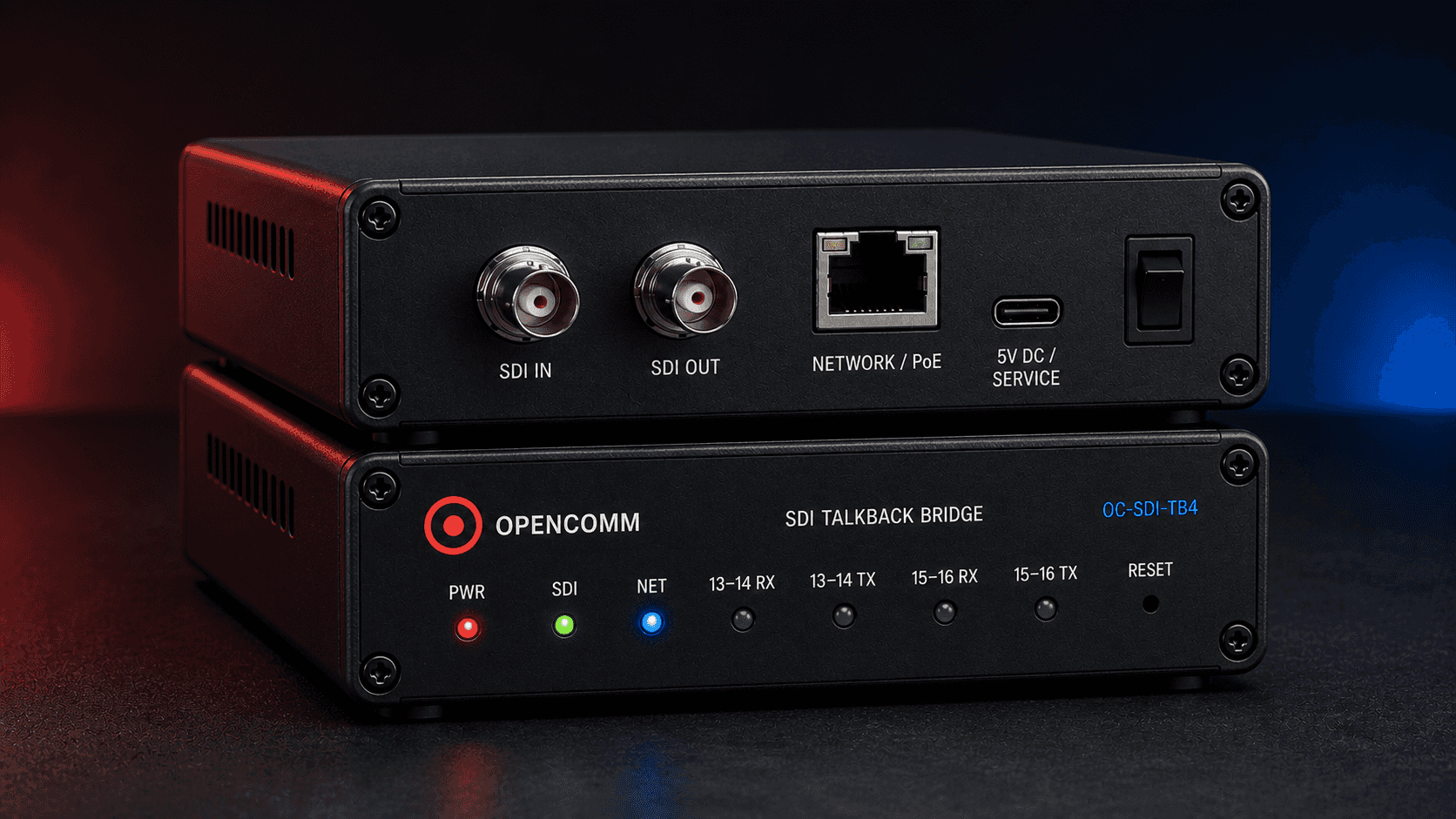
The SDI Talkback Bridge, clearly visible.
A compact unit with one SDI input and one SDI output. The bridge extracts intercom audio from 13–14 and 15–16, then embeds return audio for the Blackmagic chain.
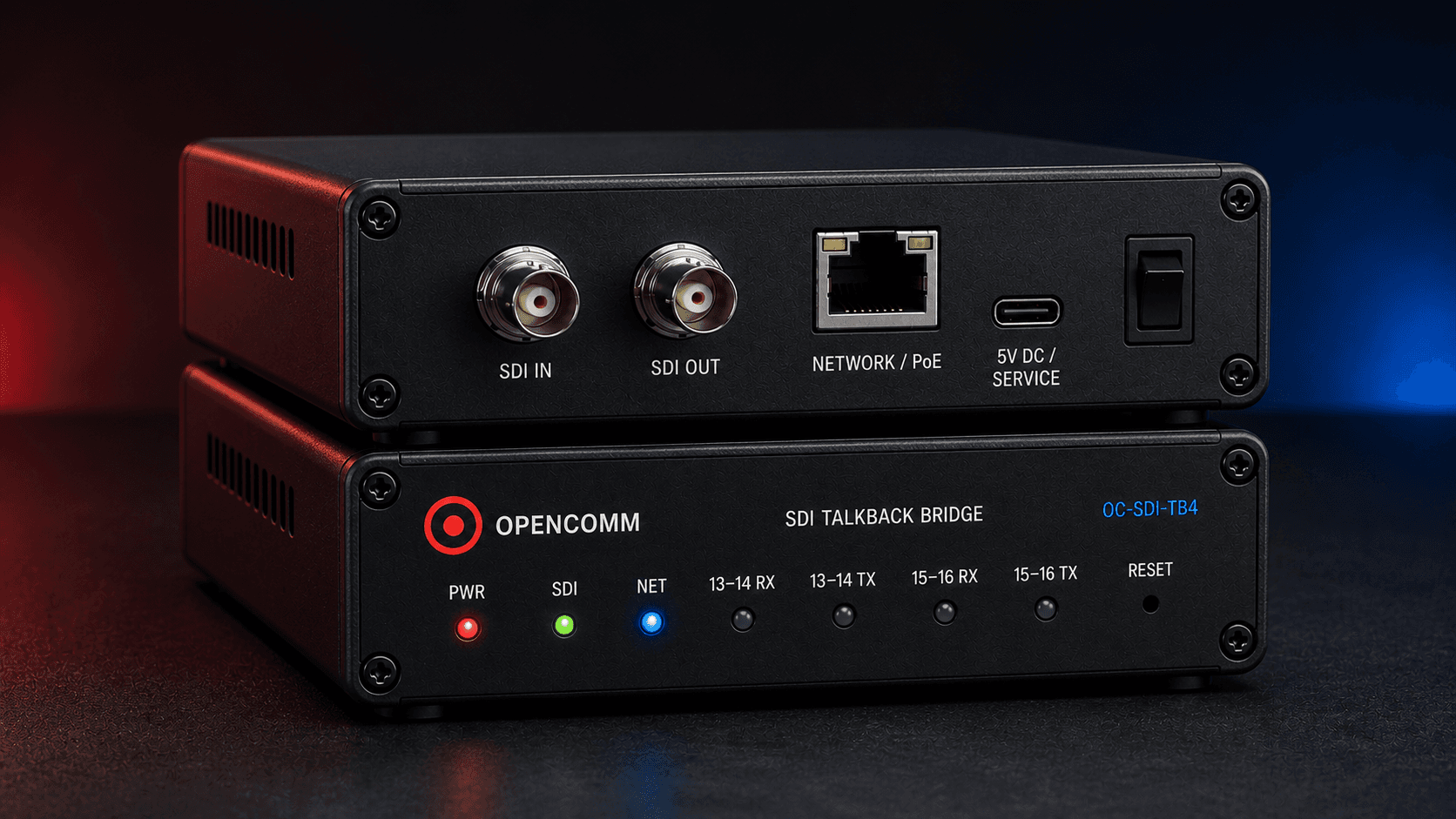
The Multi Intercom Hub connects SDI, Dante/AES67 and 4-wire.
A standalone half-rack unit for connecting and aligning the intercom systems that meet on a production. The base stays focused; AES3, analogue 2-wire and MADI can be added as targeted expansion options.
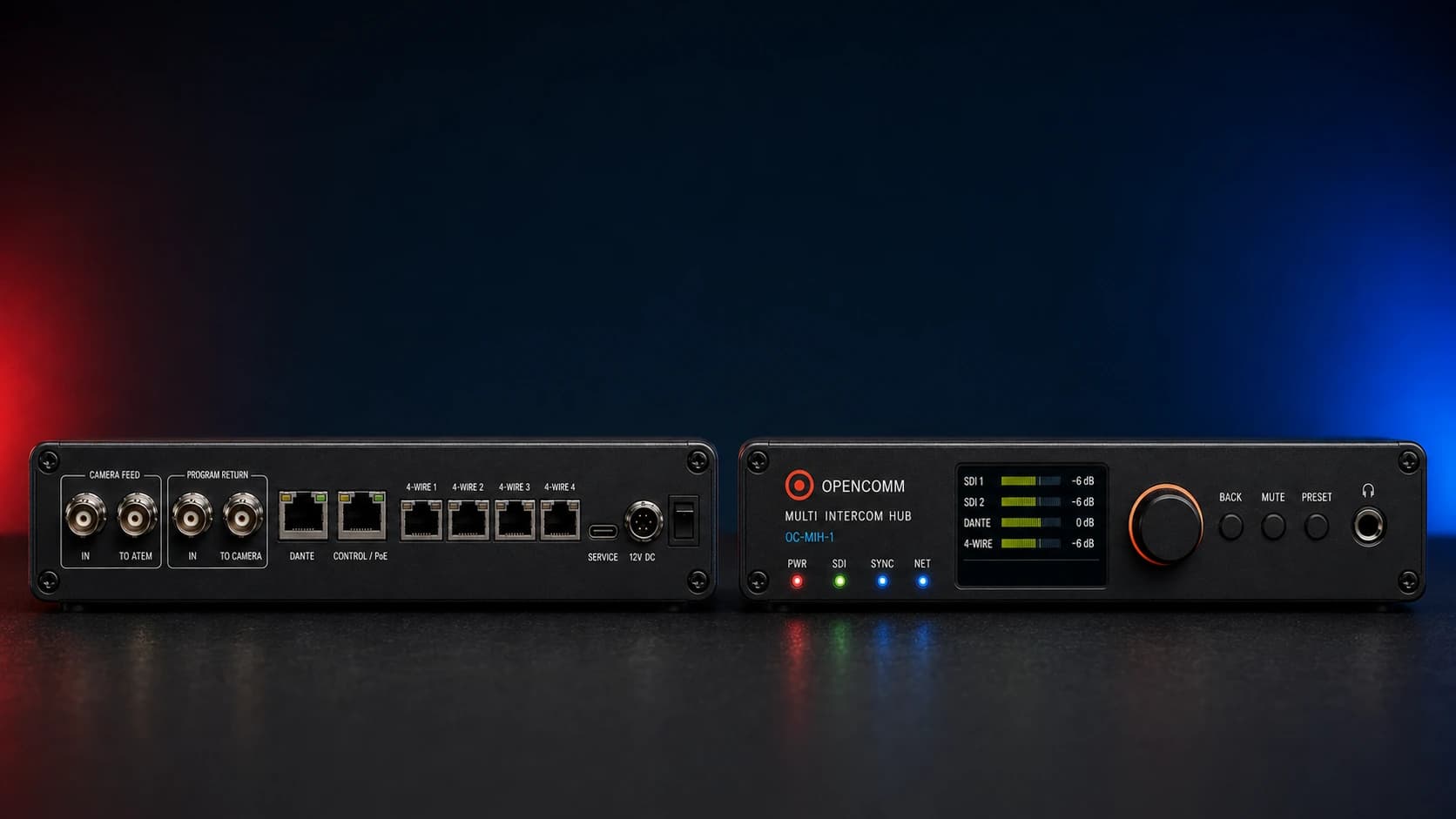
The left and right views show the same enclosure at equal scale, with identical height, width, depth and corner radius. Final exterior dimensions follow mechanical and thermal fit testing.
Inline SDI
2× IN → OUT
Camera feed and programme return both pass completely through the hub, allowing talkback channels 13–16 to be extracted and reinserted in both SDI directions.
Local alignment
Display + encoder
Meters, gain, mute, monitoring, test tone and presets are available on the front panel, without a laptop or cloud.
Audio over IP
Dante + AES67
Green-GO connects digitally through its Dante interface. An AES67-capable Dante module opens the same network ports to other professional audio systems.
Universal intercom I/O
4-wire + GPIO
Four balanced 4-wire ports get per-port gain, isolation and call/PTT GPIO for intercom matrices and camera interfaces.
Modular expansion
AES3 · 2-wire · MADI
AES/EBU, Clear-Com/RTS partyline and multichannel MADI become option cards, keeping the base affordable without closing off professional routes.
Standalone
OPENCOMM optional
Routes and levels are stored locally. OPENCOMM adds remote users and central control, but is not required.
The four BNC connections are functional: camera in and through to ATEM, plus programme return in and through to the camera. An additional fifth monitor loop remains optional and is not required for the intercom function.
The rear panel shown is deliberately the base configuration. Analogue Clear-Com or RTS 2-wire needs a true partyline interface with a hybrid, galvanic isolation, line power and call signalling; a 4-wire connection alone is not enough.
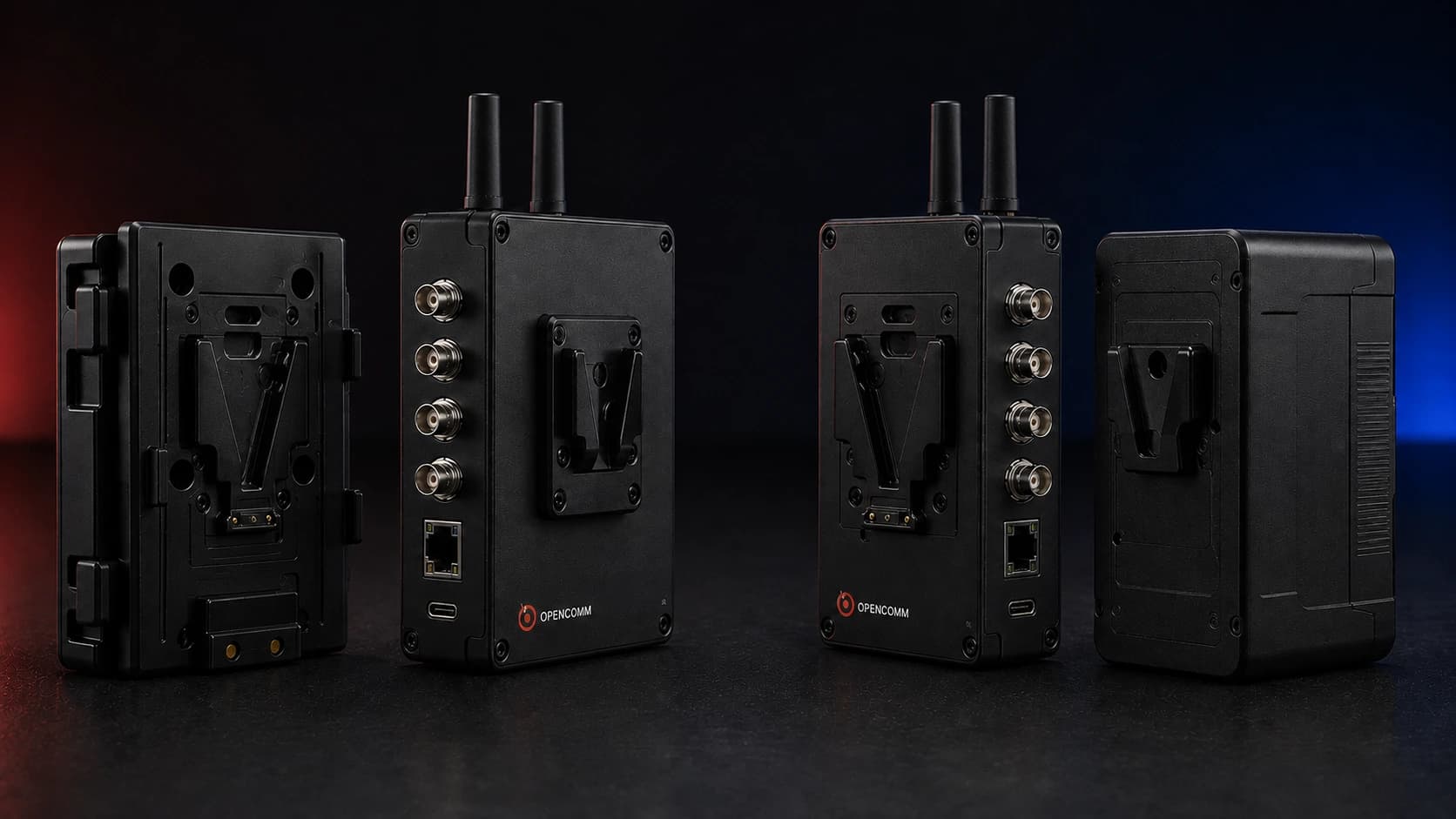
How the bridge fits between camera and battery.
The full camera is deliberately omitted. Two photorealistic close-ups show the mechanical chain: the bridge locks onto the existing V-mount plate like a battery, then provides its own V-mount receiver for the actual battery.
- Reference battery · IDX DUO-C150P
- ≈ 95 × 146 × 59 mm
- W × H × D · converted from manufacturer specifications
- Bridge · provisional enclosure dimensions
- 100 × 150 × 45 mm
- W × H × D · excluding antennas and protruding connectors
The two photographic views show opposite sides of the same bridge: camera receiver → male bridge wedge, followed by female bridge receiver → male battery wedge. Four BNCs, network and service stay on one narrow side wall and remain clear of the battery.
True sandwich
V-wedge → V-receiver
The camera side behaves like a V-mount battery; the rear of the bridge is a complete V-mount plate that locks the actual battery in place.
SDI signal path
4× BNC on one side
Camera feed and programme return each have an input and output. The connectors remain clear when the battery covers the full rear face of the bridge.
Wireless
2× folding antenna
Two short, all-black rubber antennas with black hinge points provide diversity and can fold alongside the enclosure for transport.
Power
Protected pass-through
Contacts on both mounting faces pass battery power through. A fused, monitored branch powers the bridge with minimal voltage drop to the camera.
This is a controlled interface concept, not production CAD. The battery is the dimensional reference; the bridge follows its width and height. The 45 mm depth is a design target. V-mount plates, electronics, cooling, cable clearance and battery locking determine final dimensions after fit testing on cameras including the URSA Broadcast G2.
One matrix · every device
The same production, three ways to operate.
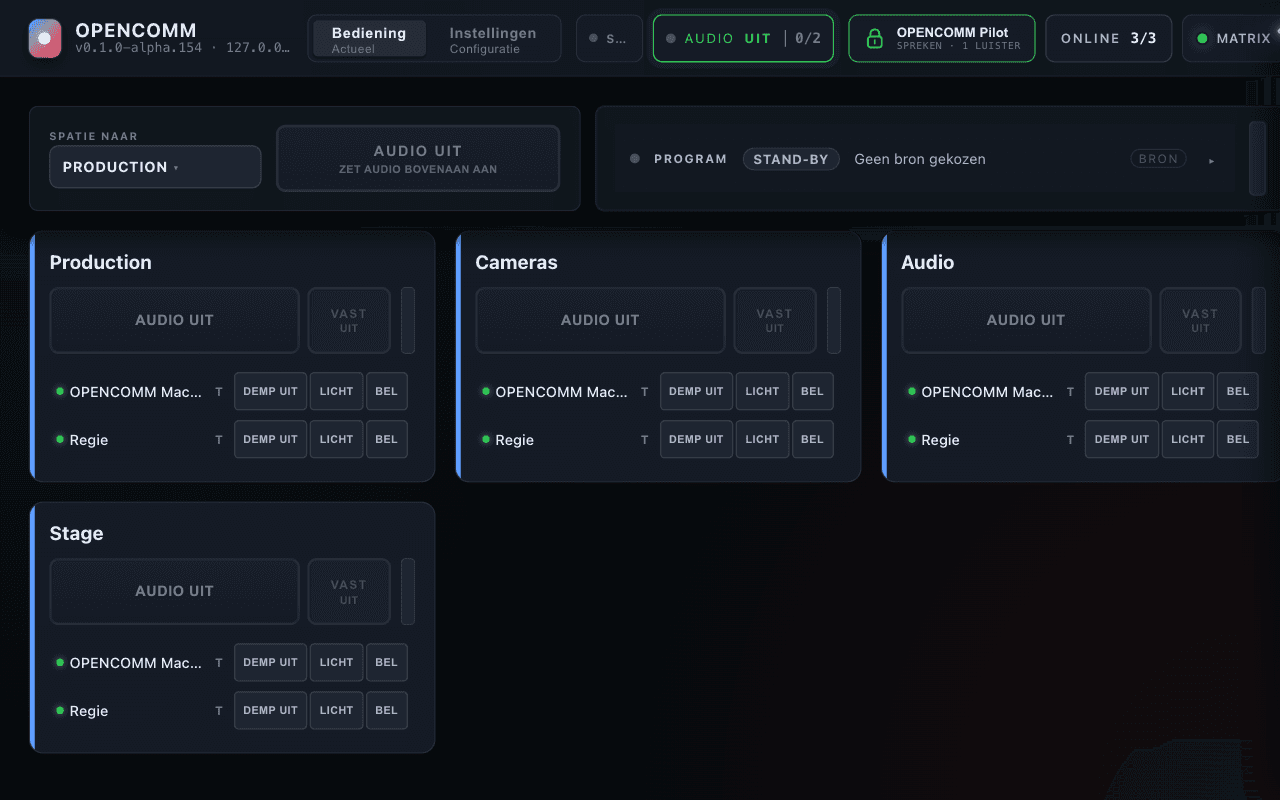
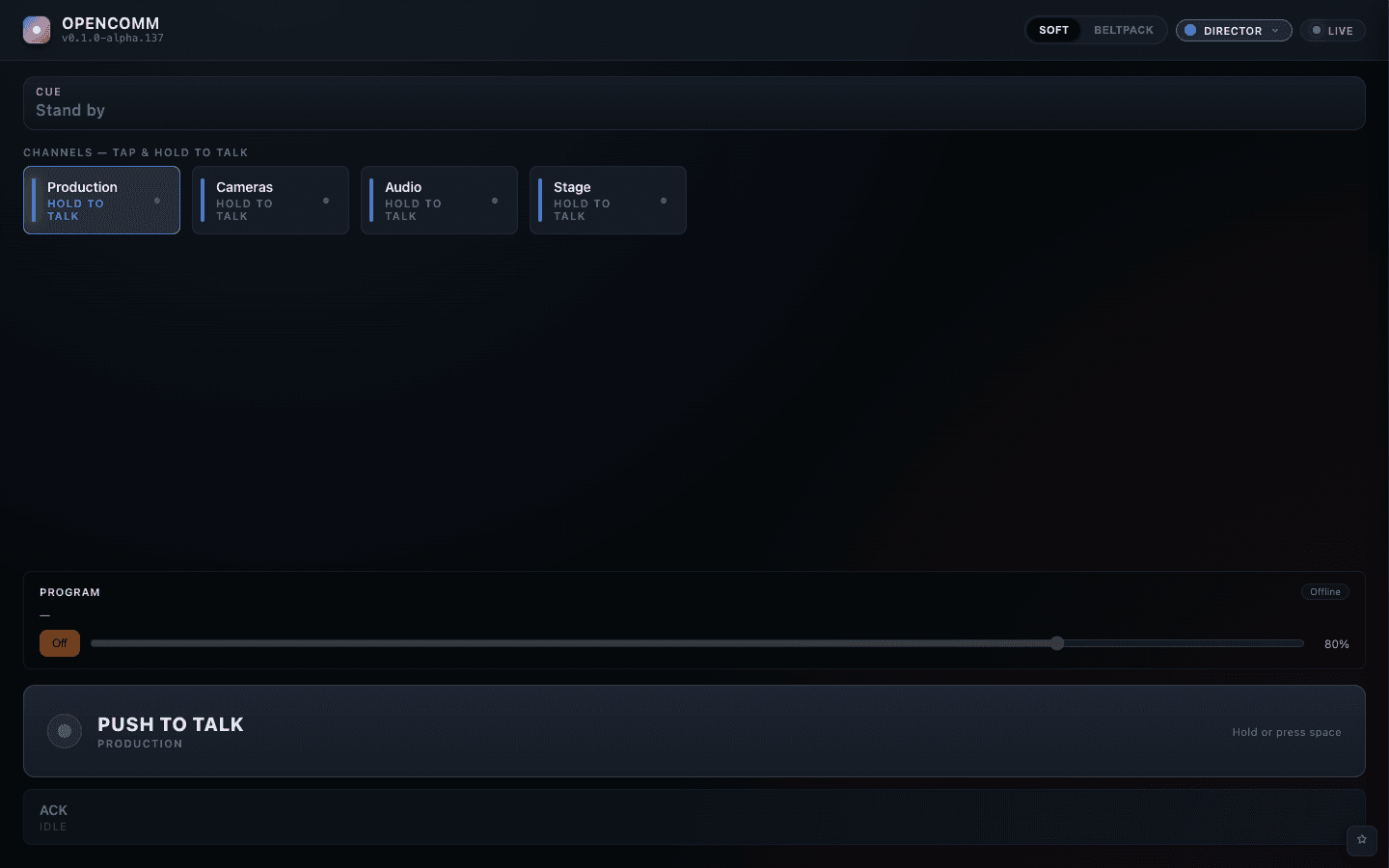
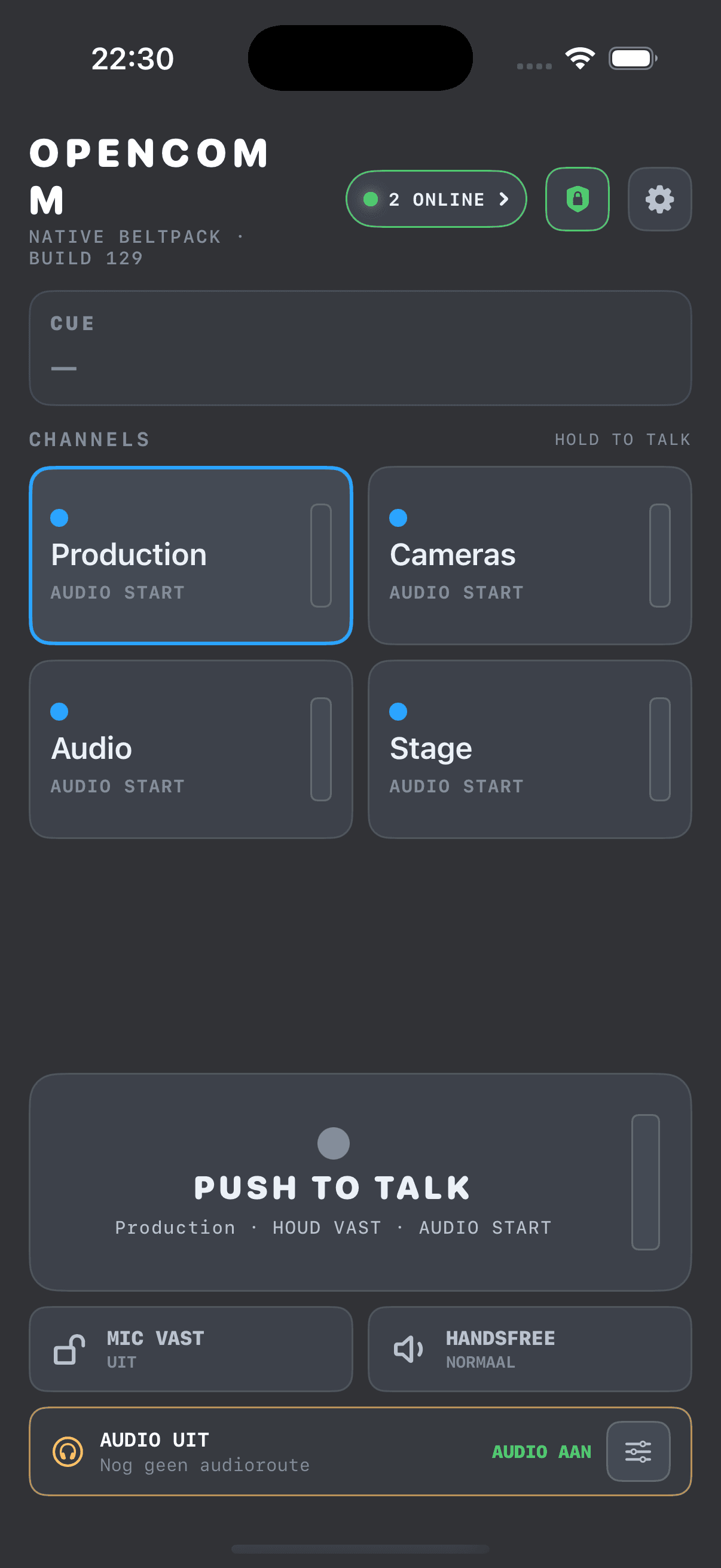
OPENCOMM gives every role the interface that fits the moment: overview on the Pi, a complete soft client on Mac and a beltpack in your pocket.
What it does
One matrix, every control surface
Pi, Mac, iPhone, iPad and custom ESP32 hardware share roles, workgroups, permissions, cues and device status. The interface changes per device; the production context stays the same.
Pi as the fixed control position
A 1280 × 800 touch interface gives the operator every workgroup, online state, programme audio, push-to-talk, latched talk and attention signal at a glance.
Mac as a complete soft client
The desktop client combines channel selection, listen, talk, programme feed, cue acknowledgement and diagnostics. A director or producer can join immediately without another beltpack.
Native iPhone and iPad beltpack
The SwiftUI client turns an Apple device into a compact intercom position with a large talk button, channel cards, audio feedback and secure device identity.
Custom ESP32-S3 hardware
For a physical beltpack we build around ESP32-S3 with Ethernet or PoE, buttons, encoder, headset interface and status LEDs. Form, firmware and unit cost stay under our control.
Local-first with a secure remote route
On the same network, audio keeps flowing directly between devices. Away from the venue, OPENCOMM uses a secure relay and TURN route with the same roles and permissions.
Private spaces and device-bound access
Ed25519 device keys, signed memberships and short-lived access tickets bind permissions to a physical device. Inviting and pairing works without a shared password.
SDI Talkback Bridge as the next step
The proof of concept receives 3G-SDI, extracts embedded audio 13–14 and 15–16 and inserts return audio on SDI out. The target is a compact in-house PCB and enclosure, without DeckLink or an off-the-shelf converter box.
How we built it
The matrix core handles real-time control over WebSocket. Audio travels peer-to-peer with WebRTC, DTLS/SRTP and Opus at 48 kHz; TURN takes over when a direct route is unavailable.
A shared TypeScript protocol keeps the Pi and Mac clients, matrix and ESP32 interface aligned. The native SwiftUI client implements the same messages and permissions on iPhone and iPad.
OPENCOMM is local-first: a production on the same network keeps working without depending on a public cloud. Private spaces can also be connected securely over the internet.
ShowCaller can send cues, tasks and attention signals to the right role or person. The recipient acknowledges the cue on the same screen used to operate the intercom.
For the SDI extension we are evaluating a custom PCB around the GS2971A receiver and GS2972 transmitter. During the demo phase the same signal chain can first be proven with an affordable development board; only the essential components then move to the in-house board.
Why we built it
Communication is infrastructure during a live production. Yet traditional intercom often locks a crew into one hardware ecosystem, with a high entry cost and little room for its own workflow.
OPENCOMM grows out of our own production floor. That makes us build what is demonstrably needed there first: fast control, intelligible audio, local resilience and the freedom to give a Pi, Apple device or custom module the same role.
Need something like this in your company?